

Room 4U
Room rental mobile app (B2C). Freelance project, Spain.
Business context: Flatsharing & co-living accommodation / Client: Private / My role: Consultant/UX Designer / Target audience: Primarily the 15-34 age group who want to rent a room


Young people in Spain have been dealing with rising rent prices for years. By August 2025, rents had gone up by 10.5% compared to the year before. Buying a home is also becoming more expensive because demand is high and there aren’t enough properties available, according to Idealista (leading real estate marketplace in Spain).
Because of this, there’s a clear need for a solution that makes renting rooms more flexible and affordable for different budgets. Below is a video that shows the user journey designed:
Want more?
Scroll down to view the design process!
1 Research
To address this problem, I followed a quick design process. In the research stage, I focused on two main tasks: 1. Competitor analysis; 2. User personas.
1.1 Competitor Analysis
First, I did a quick competitor analysis to better understand the problem and decide which features to include or avoid. This step helped me learn what users care about most in popular room rental apps.
I also found that native apps perform better than web apps. They’re faster, more responsive, and more interactive. They can fully use the device’s features—like the camera or GPS—which is especially useful for things like finding available rooms accurately on a map.


✅ Must to have
Based on feedback received through reviews in September 2025, we can summarize the following so far:
• Connect tenants directly with owners without brokerage fees.
• Real-time availability.
• Up-to-date listings (MLS databases).
• Diverse searching and filtering options.
• Map integration.
• Smooth payment and booking process.
• Visible user feedback and ratings.
• Verifications and background checks on both renters and hosts.
• Price transparency (rates, promotional offers, etc.).
• Understanding additional fees.
In short, assessing these key features can improve the overall rental experience. By examining aspects like search functions, payment processes and user reviews, we can better understand what to look for in a successful room rental app.
⚠️ Avoid
• Scams.
• Outdated listings.
• Inaccurate prices.
• Intrusive ads.
• Miscommunication with hosts.
• Discrepancies between advertised conditions and actual realities.
• Difficulty in navigating support channels.
1.2 User Personas
Who uses room rental apps? Based on different online sources like blogs and articles, they are used by a wide range of people looking to rent a room in a shared house or flat, either for short stays or longer periods:
• ★ Individuals relocating for study such as students starting university.
• Individuals relocating for work such as professionals moving to a new city.
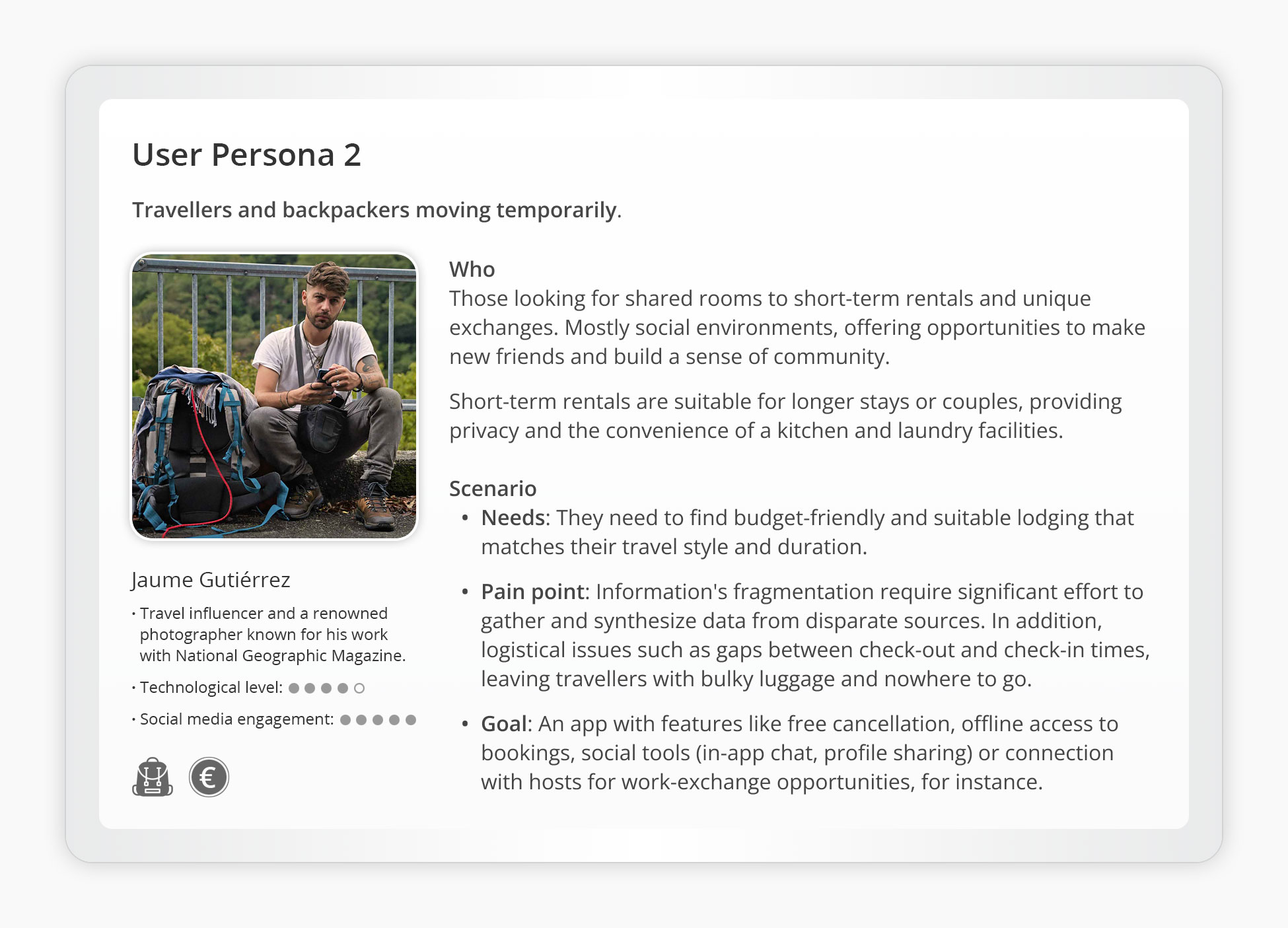
• ★ Travellers and backpackers moving temporarily.
• Those considering sharing a home to save money.
• People tired of living alone.
The current study focuses on two user personas ★ covering the different user groups listed above: 1. Individuals relocating for study such as students starting university / 2. Travellers and backpackers moving temporarily.



2 Strategy
Let’s define the problem in this second stage, as well as design guidelines in the context of the Spanish market. The goal of this project is to create an MVP product for phase 1 as a starting point.
2.1 Definition of Problem Statement
This scenario aims to represent the main problem of the user’s background in one sentence. Besides other topics such as flexibility or confidence, we may define it as follows:
[ YOUNG ADULTS who NEED to rent a room quickly BECAUSE
they want to save money while making new friends ]
2.2 Mobile-first Principle
Fast access to content is essential, and mobile optimisation helps users navigate easily anytime, anywhere.
It’s also best to design for smaller screens first, then adapt the design for larger ones. If a product works well on mobile, it usually works well on other devices too: Mobile-first is essentially content-first.


2.3 Phase 1
In Spain, Android is the most widely used mobile operating system, with a 78.8% market share. However, usage varies by age: iOS is more popular among younger people, especially those aged 15 to 34, where it has about twice the market share of Android.
Based on this, the goal is to design a mobile app for renting rooms, allowing users to find, book, and manage accommodation. In this first phase, the focus is only on renters (B2C), not property owners.
Mobile
15 to 34
iOS
B2C
Phase 2
The Android version would also be developed later to reach all types of users. The other features listed below would be added in future updates as part of an ongoing, iterative design process.
Desktop/Mobile
≥ 34
Android
B2B
3 Design
Research and Strategy provided a wider perspective about the matter. So it was time to create a potential solution, paying special attention to:
• Clarity of product data through a clean layout design visually organized on a soft 8-pixel grid which helps ensure consistency of visual spacing and element sizes.
• Frictionless user flows that minimize the effort from users, prioritizing speed in fewer steps.
3.1 Wireframes
Focused on space allocation and prioritisation of content, functionalities available, and intended behaviours. There are two user flows: 1. Registration / 2. Room rental, including the check-in process.


3.2 Mockups & Prototype
An interactive prototype that closely reflects the real product would also be created, along with a full design system to keep the style consistent. A design system is a structured and scalable way to build user interfaces, and it helps both designers and developers work more efficiently.
The Human Interface Guidelines (HIG) were also essential in designing this iOS app.


3.3 iOS App


Evaluation
What’s mainly shown here is the design approach for a room rental mobile app (phase 1) while improving the check-in process.
As a minimum viable product (MVP), it would integrate enough features to satisfy early customers and get feedback for future product development, aligned with business strategy. Most of the requirements have already been included, providing a starting point to keep iterating in the design process 🚀